How to use Match Scout
Match Scout statistically analyses upcoming matches and shows which markets are statistically interesting. Make smarter choices based on probability, not gut feeling.
What is edge?
Edge is the difference between your calculated probability of an outcome and the implied probability the bookmaker prices into their odds. A positive edge (e.g. +5%) means: statistically, the chances are better than the odds suggest. A negative edge means the bookmaker has already priced this in.
Edge says nothing about who will win. It says something about whether the odds are correctly priced relative to the expected probability.
The overview
Every upcoming match appears as a card with club logos, date, time and the model probability per market.
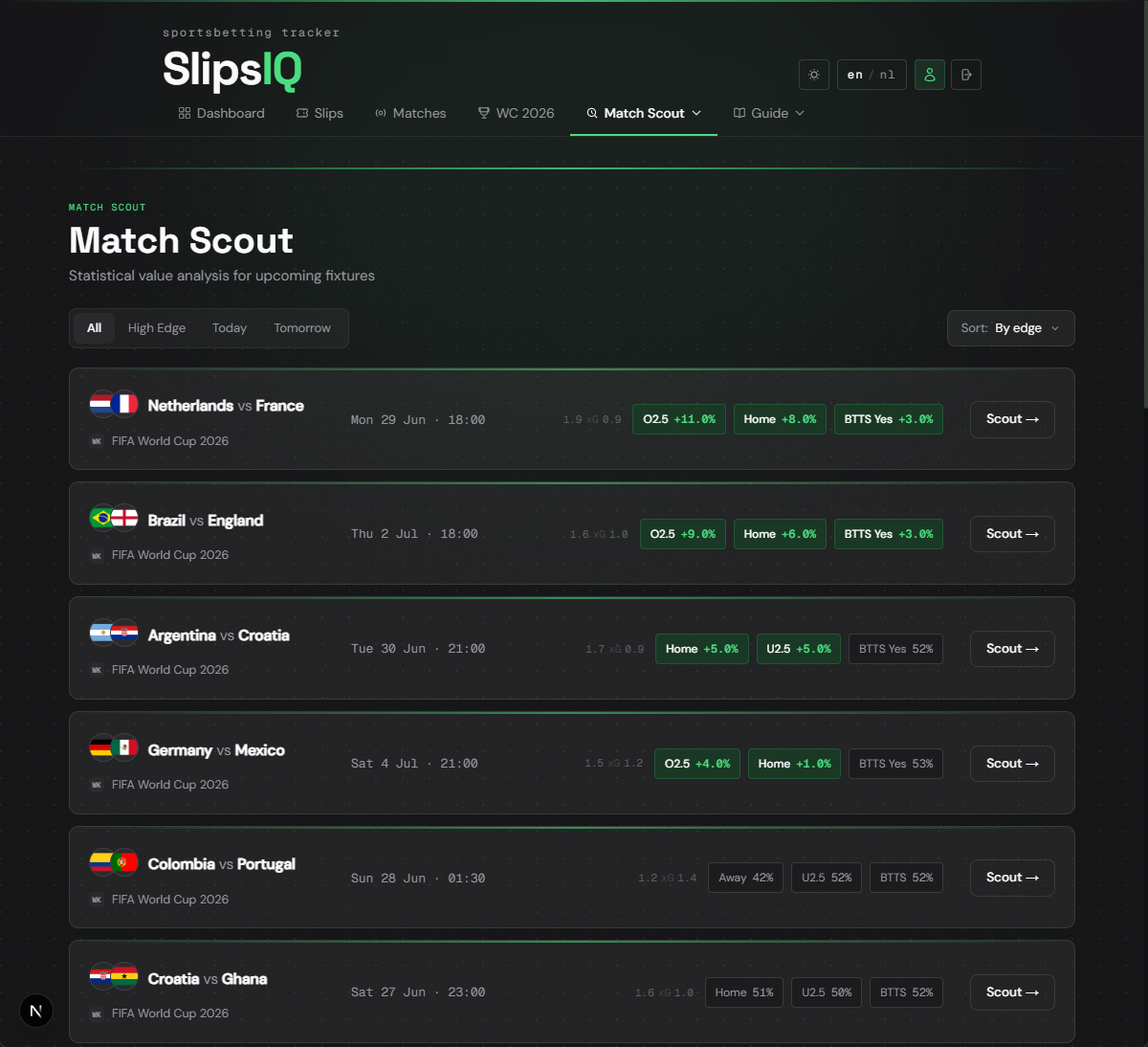
Chips explained
Each card has up to five chips showing the model probability per market type. The overview shows the model probability on its own; open a match and the report puts it next to the bookmaker price, which is where the edge appears.
Result: home, draw, or away
Over/Under goals
Both teams to score
Corners over/under
Cards over/under

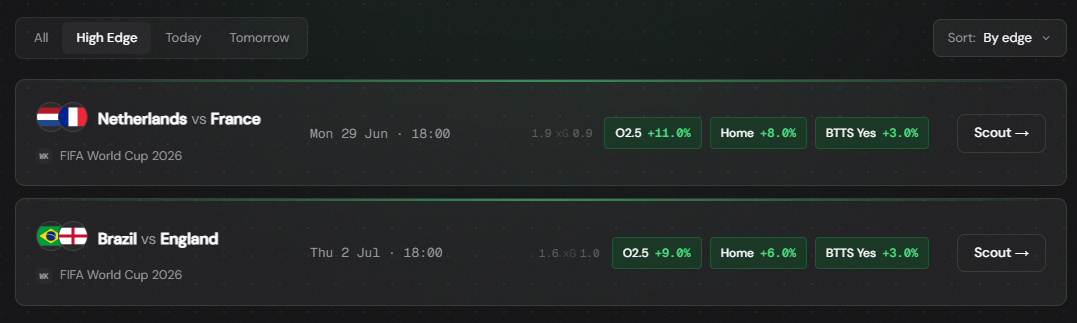
Filtering
All upcoming matches
Only matches where the model is outspoken about at least one market
Today's matches
Tomorrow's matches
Click through to the report
Click on a match card to open the full Match Scout report with detailed statistics, Poisson analysis, heatmap, H2H history, and AI summary.
Read how the report works →Premium
The full fixture list and all edge data are part of SlipsIQ Premium. Free users see a limited number of matches.
Frequently asked questions
SlipsIQ uses a Poisson model based on historical attack and defence statistics of both teams. This produces a theoretical probability distribution across all possible scores.
The fixture list refreshes every 5 minutes from the data source.
No. Signal strength says something about how outspoken the model is about a match, not about the outcome. Any individual match can go differently. Use it as one of several factors in your decision.